{{partial"shortcodes/cards.html"(dict"page"."content"(slice(dict"content""The AI native programming language.\n\n```python\nprint(\"Hello World!\")\n```""href""https://example.com""title""Python Example")(dict"content""For guys who like to tinker around.\n\n```bash\necho \"Hello World!\"\n```""title""Terminal Example")(dict"content""For the connoisseur of programming.\n\n```c\nprintf(\"Hello World!\");\n```""title""C Example")))}}
Parameters
Name
Default
Notes
columns
3
The number of columns in full width mode to display the cards in. Accepts values from 1 to 5. Numbers are reduced when width gets smaller.
template
default
The template to be used to display all cards in the set. Can be overridden for each card.
- default: The standard layout - debug: A debug layout helping you in development
Each card of the set is defined with the card shortcode.
Name
Default
Notes
href
<empty>
Either the destination URL for the card or JavaScript code to be executed on click. If this parameter is set, the card will hover on mouse over.
- if starting with javascript: all following text will be executed in your browser - every other string will be interpreted as URL, you can use link effects as well.
action
<empty>
Name of an action executed by your own script on click, without inline JavaScript. Use this instead of a JavaScript href if your site uses a strict Content Security Policy. If this parameter is set, the card will hover on mouse over. See example.
image
<empty>
URL to an image to be displayed at the start of the card.
imagealt
<empty>
Text alternative for the image, announced by a screen reader in place of the image.
Set it if the card shows nothing but its image, as the image is then the only thing left to name the card. Without it such a card falls back to the title of the page its href leads to, or to the href itself.
Leave it empty if the card also shows a title. The title names the card, so the image beside it is marked as decorative with an empty alt attribute.
title
<empty>
Arbitrary title for the card.
template
default
The template to be used to display the card. Overrides the template of the set.
- default: The standard layout - debug: A debug layout helping you in development
If you have advanced requirements to display your cards, you can place a card layout partial into layouts/partials/card that will be used for each single card.
For example, if you want to see debug output displaying the parameter the partial receives, you could set template=debug which will cause the partial layouts/partials/cards/debug.html to be called. The debug card template is shipped with the theme.
A card template will be called with all the card parameters. href and image are transformed into a form ready to be consumed.
Examples
Lots of Cards
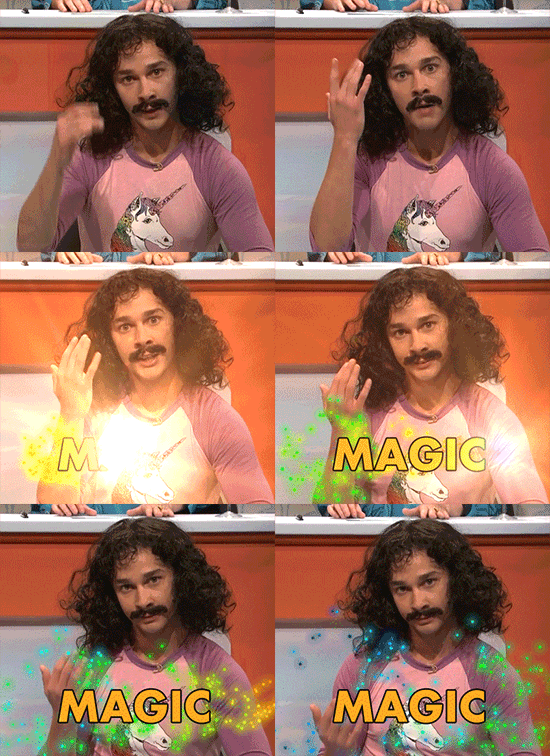
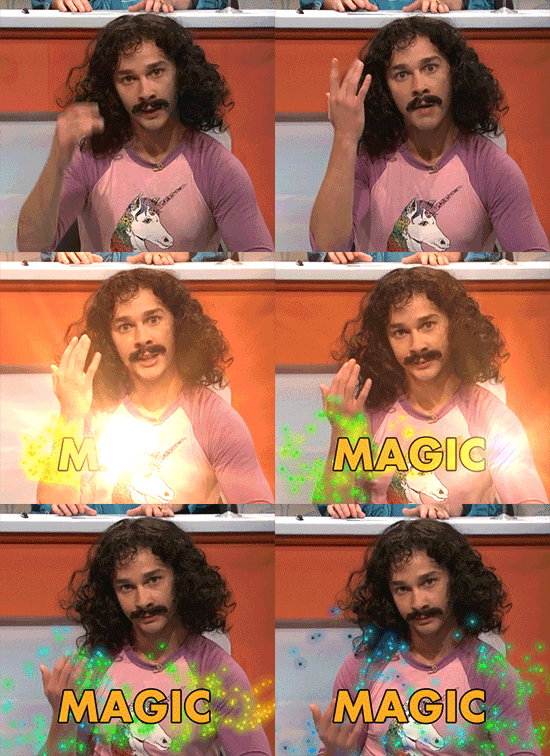
If only an image is displayed, the full card will be used. As no title is left to name the card, describe the image with the imagealt parameter.
{{<cards>}}{{%cardhref="/images/magic.gif?download"image="/images/magic.gif"title="Everything"%}}Image,title,textandhref.Youcanalsouseimageeffectsinyour`href`.Thiscardwilldownloadtheimage.{{%/card%}}{{%cardtitle="Title and Text"%}}Justatitleandatext.Youcanuseany**Markdown**inthetext{{%/card%}}{{%cardtitle="Title Only"%}}{{%/card%}}{{%cardimage="/images/magic.gif"title="Image and Title"%}}{{%/card%}}{{%cardimage="/images/magic.gif"%}}Imageandatext{{%/card%}}{{%card%}}Textonly```c
printf("Hello Code!");
```{{%/card%}}{{%cardhref="/images/magic.gif?download"image="/images/magic.gif"imagealt="A top hat with a rabbit peeking out"%}}{{%/card%}}{{</cards>}}
{{partial"shortcodes/cards.html"(dict"page"."content"(slice(dict"content""Image, title, text and href.\n\nYou can also use image effects in your `href`. This card will download the image.""href""/images/magic.gif?download""image""/images/magic.gif""title""Everything")(dict"content""Just a title and a text. You can use any **Markdown** in the text""title""Title and Text")(dict"content""""title""Title Only")(dict"content""""image""/images/magic.gif""title""Image and Title")(dict"content""Image and a text""image""/images/magic.gif")(dict"content""Text only\n\n```c\nprintf(\"Hello Code!\");\n```")(dict"content""""href""/images/magic.gif?download""image""/images/magic.gif""imagealt""A top hat with a rabbit peeking out")))}}
{{partial"shortcodes/cards.html"(dict"page"."content"(slice(dict"content""For the connoisseur of programming.""params""{\"blub\":\"bla\"}""title""C")(dict"content""For the guys that can cope with syntax.""title""C++")(dict"content""For guys that need two destructors.""title""C#"))"template""debug")}}
C
All Parameter
{"action":"","color":"","content":"For the connoisseur of programming.","href":"","hrefattributes":{},"icon":"","image":null,"imagealt":"","imageattributes":{},"onclick":"","page":"/shortcodes/cards","params":{"blub":"bla"},"style":"filled","template":"debug","title":"C"}
C++
All Parameter
{"action":"","color":"","content":"For the guys that can cope with syntax.","href":"","hrefattributes":{},"icon":"","image":null,"imagealt":"","imageattributes":{},"onclick":"","page":"/shortcodes/cards","params":null,"style":"filled","template":"debug","title":"C++"}
C#
All Parameter
{"action":"","color":"","content":"For guys that need two destructors.","href":"","hrefattributes":{},"icon":"","image":null,"imagealt":"","imageattributes":{},"onclick":"","page":"/shortcodes/cards","params":null,"style":"filled","template":"debug","title":"C#"}
Card with Own Action
The card is written with a data-button-action attribute. Handle it in your assets/js/custom.js, which the theme loads on every page.
{{%cardaction="shout"title="Shout it out"%}}Clicktogreettheworld{{%/card%}}
{{partial"shortcodes/card.html"(dict"page"."action""shout""content""Click to greet the world""title""Shout it out")}}